After eight years and $7 billion in trade, a 'win-win' agreement leaves farmers on both continents asking: who really won? CANBERRA/PARIS - The photographs from Tuesday's signing ceremony in Canberra showed the choreography of diplomatic triumph. European Commission President Ursula von der Leyen and Australian Prime Minister Anthony Albanese, hands clasped, smiles fixed, celebrating a …
Between Brussels’ Promises and the Fields’ Fury: How the EU-Australia Deal is Splitting Europe Apart
After eight years and $7 billion in trade, a ‘win-win’ agreement leaves farmers on both continents asking: who really won?
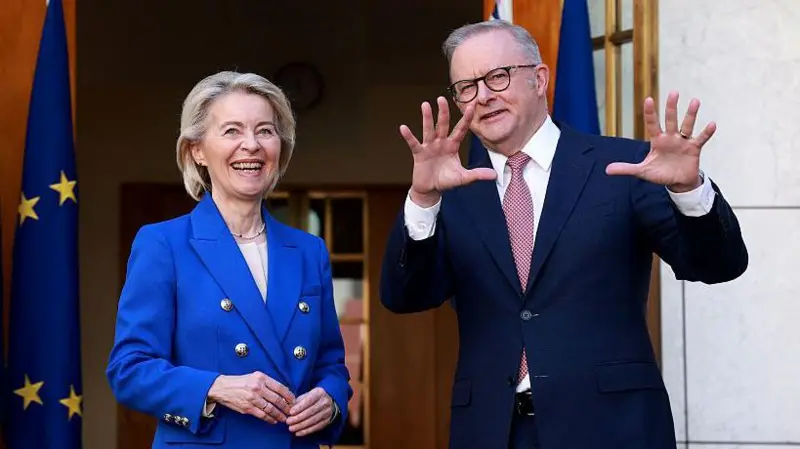
CANBERRA/PARIS – The photographs from Tuesday’s signing ceremony in Canberra showed the choreography of diplomatic triumph. European Commission President Ursula von der Leyen and Australian Prime Minister Anthony Albanese, hands clasped, smiles fixed, celebrating a “win-win” agreement eight years in the making. The deal, worth A$10 billion ($7 billion; £5.2 billion), would eliminate almost all tariffs, deepen defence cooperation, and secure European access to Australian critical minerals.
But 17,000 kilometers away, in the cattle pastures of Normandy and the sheep stations of New South Wales, a different narrative was unfolding-one that threatens to undermine the very triumph being celebrated.
The View from the Fields
Jean-Pierre Dubois has worked the same Norman land his grandfather tilled. Like thousands of European farmers, he watched Tuesday’s announcement with a familiar sense of betrayal. “They talk about collective resilience,” he said, referring to von der Leyen’s phrase describing the deal’s purpose in “a world that is deeply changing.” “But whose resilience? Not ours.”
Dubois’s anger is specific and mathematical. Under the agreement, Australian beef exports to the EU will increase more than tenfold over the next decade—from 3,389 tonnes annually to roughly 30,000 tonnes. For European consumers, this means cheaper meat. For European farmers, it means competing with imports produced under environmental and animal welfare standards far looser than the strict regulations that drive up their own costs.
“The cumulative impact of successive trade agreements makes these concessions unacceptable,” declared Copa-Cogeca, Europe’s most powerful agricultural lobby, within hours of the Canberra ceremony. The statement was bureaucratic in tone. The threat behind it was not.
European farmers have traveled this road before. The 2016 CETA deal with Canada triggered tractor blockades in Paris. The collapsed TTIP negotiations with the United States sparked mass protests across the continent. More recently, tariff-free Ukrainian grain-allowed to support Kyiv against Russia’s invasion—flooded European markets, collapsing prices and driving small farms to bankruptcy. Each time, Brussels promised safeguards. Each time, rural Europe felt sacrificed for geopolitical strategy.
Now comes Australia, with its vast ranches, its ability to undercut European prices, and a tenfold increase in market access that may be “phased” over years but feels, to farmers, merely delayed.
The Other Side of the World
If European farmers feel betrayed, their Australian counterparts feel short-changed.
Andrew McDonald of Meat and Livestock Australia pulled no punches: “This is unquestionably a missed opportunity.” Australian negotiators had demanded an annual beef quota of at least 50,000 tonnes. They received 30,000. For an industry that exports two-thirds of its production and has spent years seeking alternatives to volatile Chinese demand, the gap between hope and reality is bitter.
Australian sheep farmers secured increased access but similarly fell short of aspirations. The country’s agricultural sector, battered by climate change and market uncertainty, had looked to this deal as a historic pivot toward stable European markets. Instead, they received what McDonald called “not a fair outcome”-better than nothing, but far from enough.
The Prosecco Compromise
Amid the agricultural acrimony, the deal contains curious cultural footnotes. Australia becomes the only country outside Italy permitted to use the name “prosecco”—but only for domestic consumption, and only for ten years. After that, or for exports, Australian sparkling wine must find another name.
Italian-style parmesan will endure similar “grandfathering.” Feta faces “lengthy phase-out periods.” The compromises reveal the delicate negotiation of food identity-geographical indications Europe guards jealously as markers of cultural heritage and economic value.
Prime Minister Albanese, himself the son of migrants, framed these concessions as tribute to Australia’s multicultural history. “Whether it’s Greeks coming here and creating feta, or Italians coming and doing parmesan… it’s a connection with Europe,” he said. The sentiment was genuine. It also masked a harder truth: in modern trade diplomacy, even culinary tradition becomes transactional.
The Geopolitical Calculus
None of this, of course, is primarily about beef or cheese.
Von der Leyen’s rhetoric in Canberra made the strategic subtext explicit. “Great powers are using tariffs as leverage and supply chains as vulnerabilities to be exploited,” she warned-a clear allusion to Donald Trump’s tariff wars and China’s dominance of critical minerals like lithium and tungsten.
The EU-Australia agreement represents Brussels’ urgent diversification strategy. In January, the EU announced a landmark deal with India after two decades of negotiations. The Mercosur agreement with South America, recently derailed in the European Parliament by farming lobbies, remains politically alive. Each deal is a brick in a wall against protectionism and strategic dependency.
The new security partnership—spanning defence industry cooperation, counter-terrorism, space, maritime security, and joint critical minerals projects—cements Australia’s role as a European ally in an Indo-Pacific region increasingly shaped by Chinese military expansion. Australian lithium will flow to European battery factories. European investment will flow to Australian mines. “Trust matters more than transactions,” von der Leyen insisted.
But trust, in rural Europe, is precisely what is running out.
The Reckoning Ahead
The agreement faces a long road to implementation. Months of legal drafting lie ahead, followed by ratification by EU member states and the European Parliament. In that time, opposition will crystallize.
France, Ireland, and Poland have already signaled discomfort with the agricultural provisions. With European Parliament elections approaching and far-right parties expertly exploiting rural grievances, the Commission faces an unpalatable choice: push ahead and risk open revolt, or renegotiate and appear weak.
Farmers’ unions are already organizing. The tractors that blockaded Paris in 2016, that sprayed manure on EU buildings in 2024, will likely roll again. The “safeguard mechanisms” Brussels promises—emergency brakes if imports surge too quickly—offer little comfort to those who have heard such promises before.
A Divided Union
The crisis reveals a fundamental fracture within the European project itself. For the commission, trade openness is economic necessity and geopolitical strategy in an era of American unpredictability and Chinese assertiveness. For rural Europe, it is existential threat to a way of life.
This is not merely an agricultural dispute. It is a clash between two visions of Europe: one cosmopolitan, urban, globally integrated; the other rooted in territory, tradition, and the stubborn economics of small-scale farming. The EU has spent decades papering over this divide with subsidies and compromises. The Australia deal-and those likely to follow-may force a reckoning.
In the wheat fields of Champagne and the cattle stations of Queensland, the question is the same: when Brussels calls something a “win-win,” who exactly is winning?
The world is indeed “deeply changing,” as von der Leyen observed. Whether it is changing in the direction free traders hoped-toward open markets and collective resilience-or toward fragmentation, protectionism, and rural rage, this agreement will help decide. For now, the smiles in Canberra mask a gathering storm in the fields.

Subscribe to Our Newsletter
Keep in touch with our news & offers